There's a point in almost every growing business where the things that worked at ten employees stop working at twenty-five.
The informal processes that were fine when everyone sat in the same room become bottlenecks.
The makeshift IT setup that nobody ever formalized becomes a source of daily friction. The break-fix approach to technology, fixing things when they break and not much else, can't keep up with a team that's adding people, tools, and complexity.
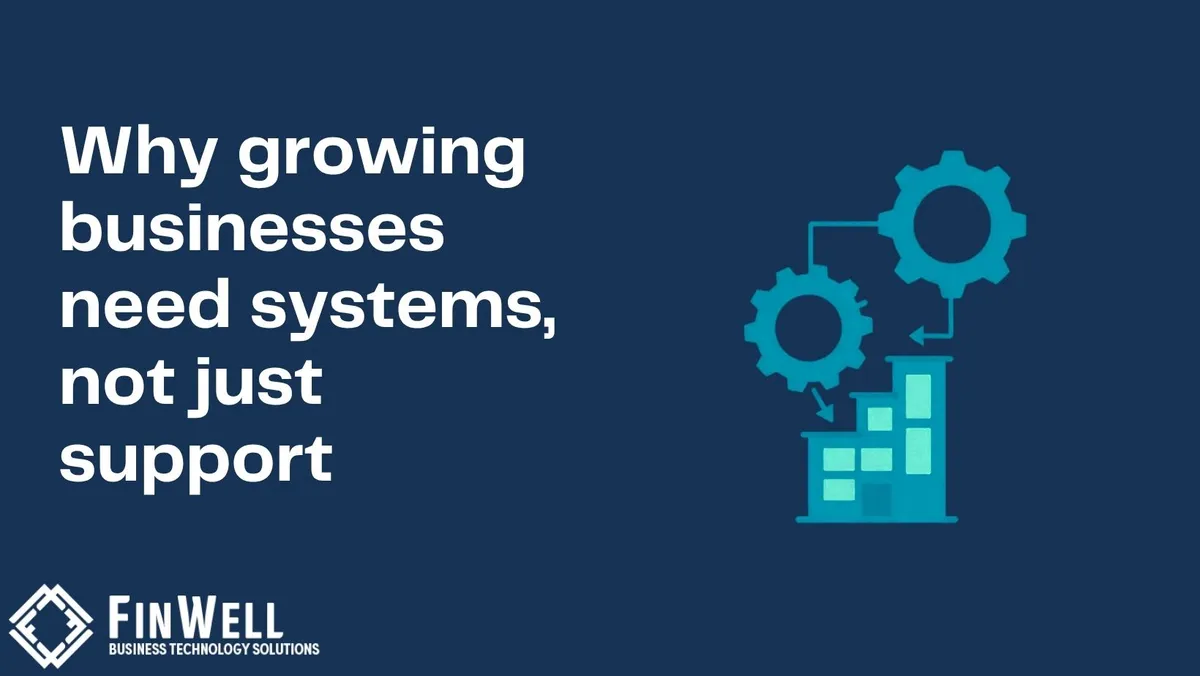
At this stage, what the business needs isn't more support. It needs systems.
When we talk about IT systems for a growing business, we're not talking about complex infrastructure or enterprise software. We're talking about the foundational things that let a team operate consistently and scale without constantly reinventing the wheel.
That includes how devices are set up and managed when new staff join. How files are organized and accessed so that the right people can find what they need without asking around. How software is deployed and updated across the organization.
How new tools get added to the environment in a controlled way that doesn't create security gaps.
These are the kinds of things that in a small organization often happen ad hoc: someone figures it out, teaches the new hire, and the process lives in someone's head. As the business grows, that approach breaks down. What used to take a quick conversation now takes two days to untangle.
Break-fix IT support works fine when the business is small and the environment is simple. You have a problem, you call someone, they fix it. That's manageable.
The problem is that break-fix support is reactive by definition. It addresses problems after they've already affected someone's ability to work. It doesn't prevent issues, doesn't proactively manage the environment, and doesn't account for growth.
As a business adds staff, devices, applications, and complexity, the frequency of break-fix events tends to increase rather than decrease. There's more that can go wrong. There's more interdependence between systems. There are more people who need access to more things.
Break-fix support scales with the number of problems, not with the efficiency of the business. At some point, it creates more friction than it removes.
When IT is managed proactively and systematically, several things change.
Onboarding new staff becomes a defined process instead of an improvised scramble. A new hire arrives, their device is ready, their accounts are set up, they have access to what they need, and someone isn't spending three days tracking down software licenses and login credentials.
Changes to the environment, like new software, new devices, changes to who has access to it in a controlled way with visibility into what exists and what changed.
This matters both for efficiency and for security.
The technology environment is documented. Not in a technical manual that nobody reads, but in a practical way that means the business isn't dependent on one person's institutional knowledge to function.
And the IT support relationship shifts from reactive vendor to strategic partner, someone who understands the business direction and helps make sure the technology supports it rather than constraining it.
The businesses that wait longest to get their IT systems in order typically pay for it in a few ways.
Recruiting and retention suffer when new employees arrive in an environment that feels disorganized and frustrating. Staff tolerance for tech friction is lower than many owners realize, especially among skilled professionals who have other options.
Growth plans slow down when technology can't keep up. Adding a department, opening a new location, or onboarding a major new client all require the systems to support the expansion. When they don't, the business hits avoidable ceilings.
And when something eventually goes wrong, like a security incident, a hardware failure, or a data loss event, the disorganized environment makes recovery significantly harder and more expensive.
You don't need to wait until you're having problems to build better systems. In fact, the best time to do it is during a period of stable growth, before the chaos sets in.
Some signals that the time has come: new hires are regularly frustrated with their technology setup. The same problems keep recurring. Nobody can give you a clear answer about what software you're running or who has access to what. You're making IT decisions reactively rather than planning for what the business needs six to twelve months out.
FinWell works with growing Spokane businesses to build the IT foundation that growth requires: organized, documented, and scaled to where the business is going, not just where it's been.
Talk to FinWell about IT systems for your growing business
No pressure, no jargon, just a clear, honest picture of where your business stands.