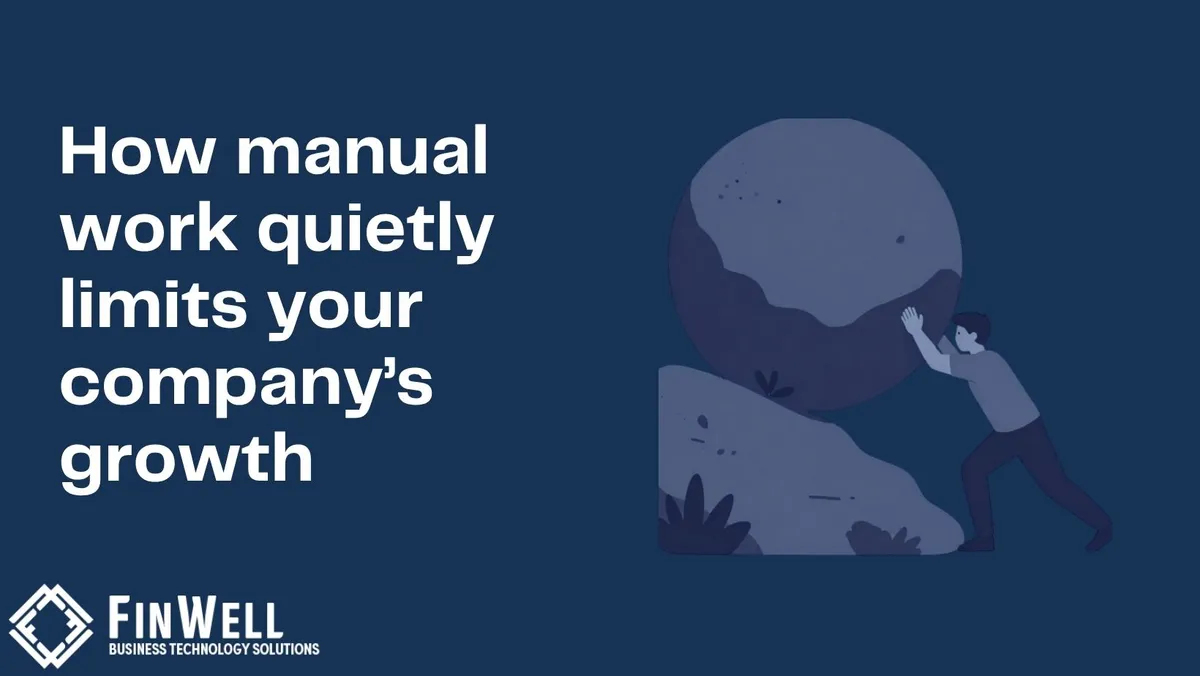
Growth feels like a good problem to have. More clients, more revenue, more opportunity. But at a certain point, something starts to drag.
Proposals take longer to get out the door. Onboarding a new hire eats a week of someone's time. The same information lives in three different places, and nobody's sure which one is current.
Simple tasks that should take minutes take an hour because the process depends on a person, not a system.
This is what manual work looks like at a growing company. And it's one of the quietest and most expensive limits on how far a business can grow.
Manual processes are usually built for the size the business was when they were created. At five people, everyone knows the system because the system is just "how we do things." At twenty people, that informal knowledge becomes a bottleneck.
The problem is that manual work rarely announces itself as a growth problem. It shows up as individual slowdowns. Someone has to ask someone else to get something done. A task can't start until a person is available.
A client waits while your team tracks down the right file or the right answer from the right person.
Each instance feels minor. The accumulation is significant.
The most direct impact of manual work is on your team's capacity. Every hour spent on a task that a system could handle, or that's slower than it needs to be because no system exists, is an hour that can't go toward client work, business development, or the things that actually grow the company.
For a professional services firm, this math is clear. Staff who are generating revenue or delivering client value are the engine of the business. When they're spending meaningful portions of their day on administrative friction, that engine is running below capacity.
For any growing service business, capacity is the constraint. Manual work is one of the most consistent drains on it.
No agreed-upon folder structure, files saved to personal drives, inconsistent naming, and version confusion. Staff spend time hunting for things that should take seconds to find.
Each new client requires someone to manually gather information, set up accounts, send welcome materials, and configure access. When this process is documented and systematized, it takes a fraction of the time.
Information that should flow automatically gets pulled manually from multiple places and assembled by a person. This might happen weekly, creating a recurring drain on someone's time that adds up significantly.
Tasks that require one person to finish before another can start, with no clear handoff system, create queues and delays that slow work down without anyone necessarily noticing why.
Emails that get rewritten from scratch each time, follow-up sequences done manually, and standard client communications that could be templated.
None of these are inherently complex problems. They persist because fixing them requires making time that feels hard to find when the business is busy.
Here's what makes manual work a growth problem rather than just an efficiency problem: the more the business grows, the worse it gets.
When you add staff, manual processes don't get faster; they get more complicated because more people are involved in them. When you add clients, the volume of manual work increases proportionally. When you add services, coordination across those services requires even more manual effort if the systems don't scale.
The businesses that grow past this point are the ones that build systems that scale with them. The ones that don't tend to hit a ceiling where growth creates more friction than it creates value, and the answer ends up being "we can't take on more clients without adding more staff," even when the underlying work doesn't require it.
Addressing manual work doesn't mean automating everything or replacing people with software. It means being deliberate about which processes need to be documented, which ones can be templated, and which ones can be handled by tools that already exist in your environment.
For most growing service businesses, this starts with identifying where time is actually going. Not the big projects, but the recurring small tasks that nobody logs because they feel routine. A few conversations with your team about what slows them down consistently will surface the highest-impact areas.
From there, the question is whether the fix is documentation, a template, a workflow in your existing software, or a new tool. Many of the most impactful improvements use tools you're already paying for but underusing.
FinWell helps growing Spokane businesses identify where manual work is costing them capacity and put practical systems in place to address it. If your team feels busier than your growth should require, that's worth looking at.
Talk to FinWell about systems for your growing business
No pressure, no jargon, just a clear, honest picture of where your business stands.